


Babesch volumes
De Aquaeductu Urbis Romae – Sextus Iulius Frontinus and the water of Rome
Series of publications by the Frontinus Society - Supplement Volume 6
Babesch volumes - Band 40
Autor: Wiplinger, G. - Frontinus-Gesellschaft
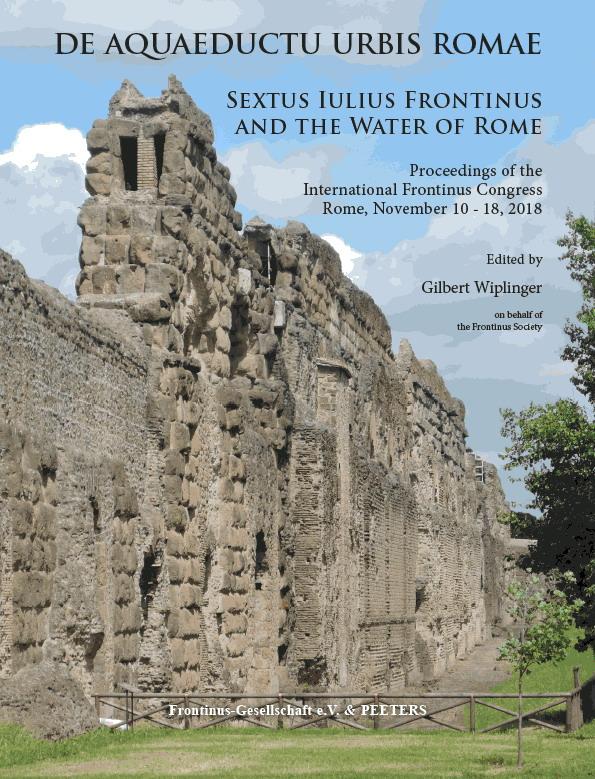
This volume is the fifth publication of a Frontinus Symposium, edited by Gilbert Wiplinger, as a BABESCH supplementary volume on historical water management. Held in the capital of the Roman Empire, where Sextus Julius Frontinus worked as curator aquarum, it was arguably one of the most important and challenging events in this series of conferences.
Of the 32 lectures and eleven poster presentations, 33 contributions are published in this volume. The first section addresses the diverse approaches to the topic of water. The second section is dedicated to the awarding of the Frontinus Medal to Hubertus Manderscheid, who was honored during the symposium for his decades of fundamental research into the history of ancient water supplies.
The third section is dedicated to the aqueducts of Rome. After a general introduction, the Colle Papese in Tivoli, the Aqua Alsietina, and the distribution of the Aqua Claudia and Anio Novus within the city were discussed. The next section dealt with aqueducts and water supply in the provinces, with presentations of Pompeii, Tauromenion (Italy), Spalato (Croatia), Parion, the Aeolian Aqueduct of Ephesus, Syedra (Turkey), Gerasa (Jordan), Sepporis (Israel), and the pre-desert areas along the African Limes.
The fifth section presented Roman latrines and baths: the latrines of Rome, especially the Baths of Caracalla, public baths in late antique Rome, and the Roman baths of Parion (Turkey). Nymphaeums were the subject of the sixth section, featuring utilities and water effects in nymphaeums of the Roman Imperial period, a fountain of a triclinium near the Temple Mount in Jerusalem, fountains in the hillside houses of Ephesus, and the impressions of water on all the senses in Roman and late antique elite houses.
The seventh section deals with the topic of hydraulics: Frontinus’ Quinaria, the aqueduct and castellum of Nimes, and the planning and construction of an aqueduct without the use of surveying instruments. The final section summarized various topics, including the sense of water in Trajan’s time, horizontal water diversions in Ostia, and water machines in medieval Arabic texts.
Details
Erschienen: 2020
ISBN: 978-90-429-4311-7
BABESCH Supplement 40
pages: XXXIV-403,
soft cover 27,5 x 21 cm
Peeters Publishers, Leuven
30,00 € for Non-Members, 20,00 € for Members, 15,00 € for student members and members under 25 years of age (available at the Frontinus Society office, all prices plus shipping costs, Contact)
Babesch volumes
De Aquaeductu Urbis Romae – Sextus Iulius Frontinus and the water of Rome
Series of publications by the Frontinus Society - Supplement Volume 6
Babesch volumes - Volume 40
Author: Wiplinger, G. - Frontinus-Gesellschaft
This volume is the fifth publication of a Frontinus Symposium, edited by Gilbert Wiplinger, as a BABESCH supplementary volume on historical water management. Held in the capital of the Roman Empire, where Sextus Julius Frontinus worked as curator aquarum, it was arguably one of the most important and challenging events in this series of conferences.
Of the 32 lectures and eleven poster presentations, 33 contributions are published in this volume. The first section addresses the diverse approaches to the topic of water. The second section is dedicated to the awarding of the Frontinus Medal to Hubertus Manderscheid, who was honored during the symposium for his decades of fundamental research into the history of ancient water supplies.
The third section is dedicated to the aqueducts of Rome. After a general introduction, the Colle Papese in Tivoli, the Aqua Alsietina, and the distribution of the Aqua Claudia and Anio Novus within the city were discussed. The next section dealt with aqueducts and water supply in the provinces, with presentations of Pompeii, Tauromenion (Italy), Spalato (Croatia), Parion, the Aeolian Aqueduct of Ephesus, Syedra (Turkey), Gerasa (Jordan), Sepporis (Israel), and the pre-desert areas along the African Limes.
The fifth section presented Roman latrines and baths: the latrines of Rome, especially the Baths of Caracalla, public baths in late antique Rome, and the Roman baths of Parion (Turkey). Nymphaeums were the subject of the sixth section, featuring utilities and water effects in nymphaeums of the Roman Imperial period, a fountain of a triclinium near the Temple Mount in Jerusalem, fountains in the hillside houses of Ephesus, and the impressions of water on all the senses in Roman and late antique elite houses.
The seventh section deals with the topic of hydraulics: Frontinus’ Quinaria, the aqueduct and castellum of Nimes, and the planning and construction of an aqueduct without the use of surveying instruments. The final section summarized various topics, including the sense of water in Trajan’s time, horizontal water diversions in Ostia, and water machines in medieval Arabic texts.
Details
Published: 2020
ISBN: 978-90-429-4311-7
BABESCH Supplement 40
pages: XXXIV-403,
soft cover 27,5 x 21 cm
Peeters Publishers, Leuven
30,00 € for Non-Members, 20,00 € for Members, 15,00 € for student members and members under 25 years of age (available at the Frontinus Society office, all prices plus shipping costs, Contact)